
Solar water heaters: types, tanks, savings and payback
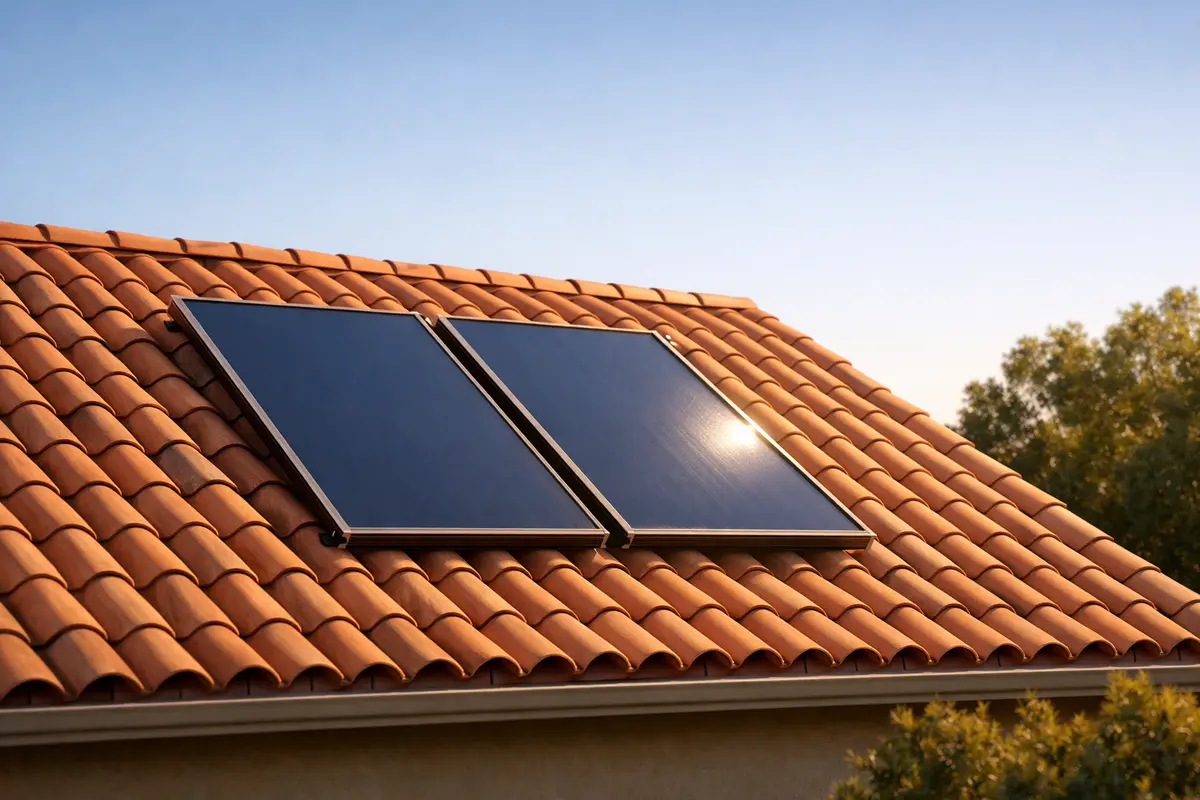
Roof collectors heat water into an insulated tank, with a conventional heater as backup. DOE says bills for water heating fall by more than half on average. Systems cost more up front and pay back fastest where energy is expensive.
On this page
Water heating is one of the larger energy costs in most homes, and a solar water heater is one of the oldest ways to cut it. The Department of Energy says solar water heaters can be used in any climate and that, on average, water heating bills drop 50% to 80% once one is installed. They cost more to buy and install than a conventional heater, so the useful questions are which type suits your climate, how the tank works, what it saves and how long it takes to pay back. This guide answers each from DOE's material.
The parts
Every solar water heater has solar collectors, usually on the roof, and a storage tank. DOE says most need a well-insulated storage tank with an extra inlet and outlet connected to the collectors. Systems come in two layouts. In a two-tank system, the solar tank preheats water before it goes into your conventional water heater. In a one-tank system, the backup heater and the solar storage are combined in a single tank. DOE notes that solar systems almost always need a backup for cloudy days and times of heavy use, and a conventional storage water heater usually provides it.
Active and passive systems
Active systems use pumps and controls. Direct circulation systems pump household water through the collectors and work well where it rarely freezes. Indirect systems pump a non-freezing fluid through the collectors and a heat exchanger, which then heats the household water; DOE says these are popular where freezing is common.
Passive systems have no pumps. DOE says they are typically less expensive and usually less efficient than active systems, but can be more reliable and may last longer. An integral collector-storage system, also called a batch system, is a tank or tubes inside an insulated, glazed box; it preheats water on its way to the conventional heater and suits places that rarely freeze. A thermosyphon system heats water in a roof collector and lets it flow into the house when a tap opens; DOE says most have a 40 gallon capacity.
The collectors themselves are flat-plate panels, integral collector-storage boxes or rows of evacuated glass tubes, which DOE says are used more often in commercial systems.
How efficient is it?
DOE uses two ratings. The solar energy factor (SEF) is the energy the system delivers divided by the electricity or gas it uses; higher is better. SEFs range from 1.0 to 11, and systems rated 2 or 3 are the most common. The solar fraction is the share of your water heating load the sun covers; DOE says typical values are 0.5 to 0.75. Certified systems and their ratings are listed by the Solar Rating and Certification Corporation. DOE adds a caution: do not choose on efficiency alone, because size and total cost matter as much.
Cost and payback
DOE's worked example puts a typical home system, two collectors covering 64 or 80 sf, at on the order of $4,000. With the gas and electricity prices it assumes, the simple payback comes out at about 15.3 years against natural gas and 14.5 years against electricity. Payback is shorter where energy costs more, which is why DOE says most installations are in high-price areas and places without low-cost natural gas. Your own figure depends on how much hot water you use, your sunshine, your fuel price and the quote you get.
The federal Residential Clean Energy Credit used to cover solar water heaters. The IRS says it is not available for property placed in service after December 31, 2025; our guide to home energy credits after that date explains who can still claim. Some states and utilities run their own programs, which change often.
Installing and maintaining it
DOE recommends a qualified solar thermal contractor, because installation depends on your solar resource, climate, local codes and safety. Before buying, DOE says to estimate cost and efficiency, evaluate how much sun your site gets, size the system and check local codes and homeowner rules. When you interview installers, ask about their experience with the type of system you want, how many years they have done it, and whether they hold the plumbing or solar license your state requires; your state licensing board can confirm it and tell you about complaints.
Passive systems need little upkeep. DOE says simple systems may need maintenance only every 3–5 years, while systems with electrical parts usually need a replacement part or two after 10 years. In dry places the glazing may need cleaning.
Worked example
Priya heats water with electricity in a sunny, mild climate where it rarely freezes, and her electricity is expensive. She asks two installers to quote. One proposes a thermosyphon system on the roof; the other an active direct system. Both are suited to her climate, so she compares their certified SEF and solar fraction, the warranty and the price. She uses DOE's example as a sense check on the quotes and on payback, notes that the federal credit no longer applies to a new installation, and asks her utility about any program of its own before signing with the installer who has the longer local track record.
Related
If the hot water stops altogether, start with the water heater troubleshooter. For lower bills from the heater you have, see the winter bill reduction checklist.
Sources
- U.S. Department of Energy, Energy Saver: Solar Water Heaters (archived June 27, 2026) web.archive.org
- U.S. Department of Energy, Energy Saver: Estimating the Cost and Energy Efficiency of a Solar Water Heater (archived May 17, 2026) web.archive.org
- Internal Revenue Service, Residential Clean Energy Credit irs.gov