
Window vs portable vs mini-split AC: which to buy
A window unit is the cheapest way to cool one room. A portable unit is the fallback when a window unit is not allowed and costs more to run. A ductless mini-split costs more to install but heats and cools efficiently, and suits owners cooling one or more rooms for years.
On this page
Window, portable and mini-split air conditioners all cool a room, but they differ in what they cost to put in, what they cost to run and who is allowed to install them. This selector asks whether you own or rent, how much of the home you want to cool, whether you want heat too and whether you can use a window, then points to the type that fits. The sections below explain the trade-offs behind each answer.
Window, portable or mini-split AC?
Answer a few questions about the space, your window and whether you rent. You get the type of air conditioner that fits and how to size it.
Do you own the home, or rent?
A mini-split needs a hole through an outside wall and an outdoor unit, so a renter needs the landlord's written permission.
I own it
How much of the home do you want to cool?
One room
Would you also like it to heat that room in winter?
Yes, heating too
Likely fit
A single-zone ductless mini-split heat pump
For one room that needs cooling and heating, DOE points to a ductless minisplit heat pump. It usually needs only a three-inch hole through the wall, the outdoor unit can sit up to 50 feet away, and ductless minisplits can reach 15.2 and 35 SEER2. It costs more to install than a window unit, so it pays off best in a room you use every day.
What to do
- Have a qualified HVAC contractor size it. DOE says oversized indoor units short-cycle and fail to control humidity.
- Plan where the condensate drains outdoors and where the indoor head will go.
- Look for an ENERGY STAR certified model.
No, cooling only
Is there a window in the room that a unit can sit in or straddle, and are you allowed to use it?
Many leases and building rules limit window units. Check before you buy.
Yes
Likely fit
A window (room) air conditioner
A window unit is the low-cost way to cool one room. DOE says room air conditioners cost less to run than central units, and they typically range from 5,500 to 14,000 BTU per hour. ENERGY STAR's U-shaped and saddle models straddle the sill so you can still open the window, and put the noisy compressor outside.
What to do
- Size it to the room: DOE says you typically need about 20 BTU per square foot. An oversized unit cools fast but leaves the room damp and clammy.
- Check the circuit. DOE says small units plug into an ordinary household outlet not shared with major appliances; larger ones need a dedicated circuit.
- Install it level and use the insulation panels in the box. ENERGY STAR says a poorly installed unit leaks as much air as a 6-square-inch hole.
- Look for the ENERGY STAR label; most certified models have a variable speed compressor.
No, or the rules say no
Likely fit
A portable air conditioner
When a window unit is not allowed or will not fit, a portable unit is the fallback. Expect to pay more to run it: comments DOE summarized in its portable AC rule describe portable units as using approximately twice as much energy as room units. A single-duct model exhausts room air outside, which pulls warm air back in through gaps, offsetting part of the cooling.
What to do
- Compare models by their seasonally adjusted cooling capacity (SACC) rather than the biggest BTU number on the box. SACC is the rating DOE's test uses.
- Prefer a dual-duct model if you can. Its second hose brings outdoor air in to cool the unit instead of drawing it from the room.
- Keep the exhaust hose short and straight, and seal the window kit well.
- Plan for the condensate: check whether the model evaporates it, drains it or collects it in a bucket you empty.
Several rooms, or the whole home
Likely fit
A multi-zone mini-split, or central air if you have ducts
For several rooms, window units add up and leave cold spots. A multi-zone minisplit runs up to four indoor units from one outdoor unit, each with its own thermostat, and avoids duct losses, which DOE says can exceed more than 30% of heating and cooling energy. If the house already has good ducts, DOE says central air is more efficient than room units, and a heat pump can replace both the air conditioner and the furnace.
What to do
- Ask contractors to quote both a multi-zone minisplit and a ducted heat pump or central air, with a load calculation (ACCA Manual J) for each.
- If you go ducted, ask that the ducts be sealed with mastic and insulated.
- Ask for ENERGY STAR certified equipment.
I rent
Is there a window in the room that a unit can sit in or straddle, and are you allowed to use it?
Many leases and building rules limit window units. Check before you buy.
Yes
Likely fit
A window (room) air conditioner
A window unit is the low-cost way to cool one room. DOE says room air conditioners cost less to run than central units, and they typically range from 5,500 to 14,000 BTU per hour. ENERGY STAR's U-shaped and saddle models straddle the sill so you can still open the window, and put the noisy compressor outside.
What to do
- Size it to the room: DOE says you typically need about 20 BTU per square foot. An oversized unit cools fast but leaves the room damp and clammy.
- Check the circuit. DOE says small units plug into an ordinary household outlet not shared with major appliances; larger ones need a dedicated circuit.
- Install it level and use the insulation panels in the box. ENERGY STAR says a poorly installed unit leaks as much air as a 6-square-inch hole.
- Look for the ENERGY STAR label; most certified models have a variable speed compressor.
No, or the rules say no
Likely fit
A portable air conditioner
When a window unit is not allowed or will not fit, a portable unit is the fallback. Expect to pay more to run it: comments DOE summarized in its portable AC rule describe portable units as using approximately twice as much energy as room units. A single-duct model exhausts room air outside, which pulls warm air back in through gaps, offsetting part of the cooling.
What to do
- Compare models by their seasonally adjusted cooling capacity (SACC) rather than the biggest BTU number on the box. SACC is the rating DOE's test uses.
- Prefer a dual-duct model if you can. Its second hose brings outdoor air in to cool the unit instead of drawing it from the room.
- Keep the exhaust hose short and straight, and seal the window kit well.
- Plan for the condensate: check whether the model evaporates it, drains it or collects it in a bucket you empty.
Window units
A window unit, which DOE and ENERGY STAR call a room air conditioner, sits in or across a window and cools one room. DOE says room units cost less to run than central systems, though they are generally less efficient, and that they typically range from 5,500 to 14,000 BTU per hour. Sizing matters more than people expect: DOE suggests about 20 BTU of capacity per square foot, and both DOE and ENERGY STAR warn that an oversized unit cools the air before it can remove the humidity, leaving the room damp and clammy.
ENERGY STAR's newer designs fix two old complaints. U-shaped and saddle-style units straddle the sill, so the window still opens and closes, and they put the noisy compressor outside. Most certified models also use a variable speed compressor, which runs more quietly and saves energy compared with one that just switches on and off. Installation is where many units lose their savings: ENERGY STAR says a poorly installed room air conditioner leaks as much air as a 6-square-inch hole, so use the insulation panels in the box and make sure the unit sits level so it drains.
Portable units
A portable air conditioner rolls on the floor and vents hot air through a hose to a window kit. It is the answer when a building forbids window units or the window will not take one, and it costs more to run. In its portable air conditioner rule, DOE summarized comments describing portable units as using approximately twice as much energy as room units. Part of the reason is in how single-duct models work: they exhaust room air outdoors, and the same amount of warmer air leaks back in through gaps, offsetting some of the cooling. A dual-duct model draws its own outdoor air through a second hose.
When you compare portables, look for the seasonally adjusted cooling capacity (SACC). DOE's test measures it to reflect real use, so it is usually lower than the headline BTU number. Federal efficiency standards applied to portable units made from January 10, 2025, but on May 16, 2025 DOE proposed withdrawing portable air conditioners from federal coverage, so check the label and reviews rather than assuming a minimum efficiency.
Ductless mini-splits
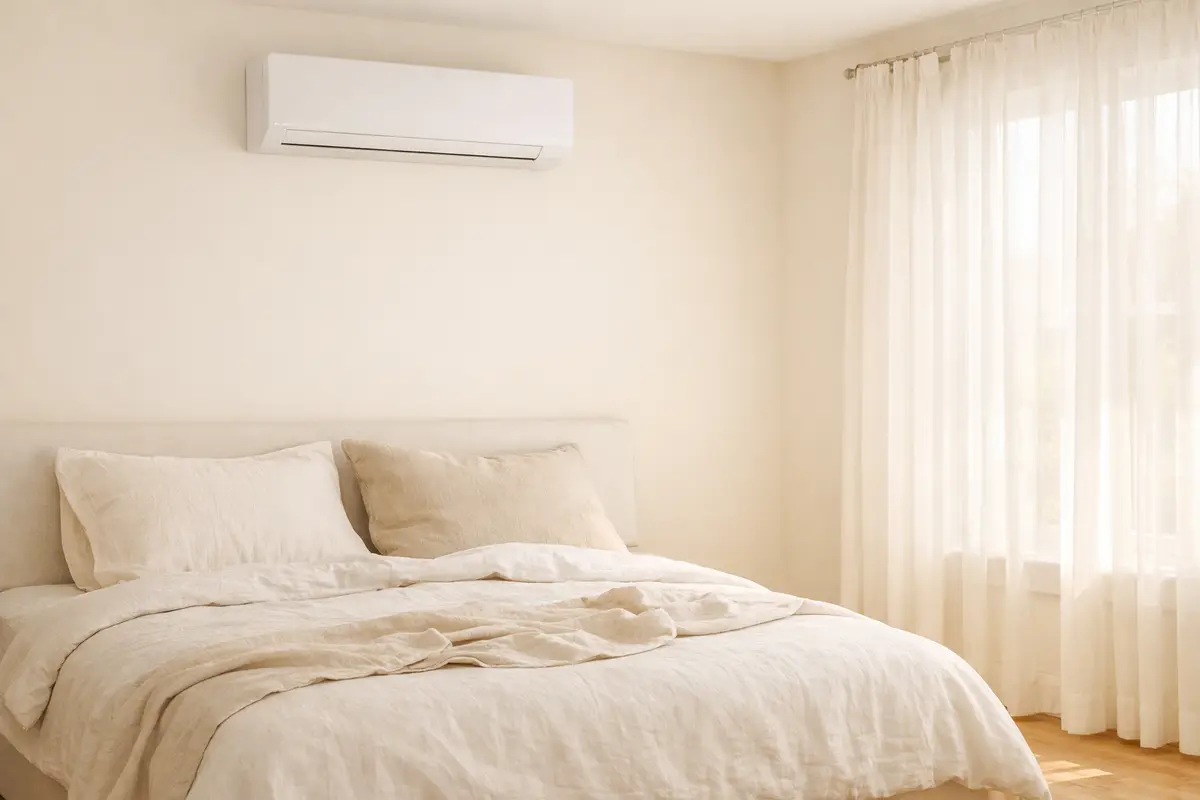
A mini-split has an outdoor unit and one or more indoor units on the wall, connected through a small hole. DOE says the hole is usually only three-inch, the outdoor unit can be up to 50 feet away, and many systems run up to four indoor units from one outdoor unit, each with its own thermostat. Because there are no ducts, there are no duct losses, which DOE says can exceed more than 30% of the energy used for heating and cooling. Mini-splits are heat pumps, so they also heat. The trade-off is the upfront cost and the need for a qualified installer to size and place each indoor unit. If the home already has ducts in good shape, DOE notes that central air is more efficient than room units.
Worked example
Jordan rents a top-floor apartment with one hot bedroom. In the selector Jordan answers that they rent and that the bedroom window can take a unit, which the building allows. The result is a window unit. The bedroom is about twelve feet by fourteen, so Jordan uses DOE's rule of thumb to pick a small unit rather than the biggest one on sale, chooses an ENERGY STAR model with a variable speed compressor, and seals it with the panels from the box. A friend in a building that bans window units gets the portable result instead and looks for a dual-duct model with a good SACC rating.
Related
If a window unit ices over, see AC freezing up, which now covers window units. For whole-house heating and cooling, the heat pump vs furnace selector is the next step.
Sources
- U.S. Department of Energy, Energy Saver: Room Air Conditioners (archived June 17, 2026) web.archive.org
- ENERGY STAR, Room Air Conditioners energystar.gov
- U.S. Department of Energy, Energy Saver: Ductless Minisplit Heat Pumps (archived June 18, 2026) web.archive.org
- U.S. Department of Energy, Energy Saver: Central Air Conditioning (archived June 14, 2026) web.archive.org
- U.S. Department of Energy, Energy Conservation Standards for Portable Air Conditioners (Federal Register, January 10, 2020) federalregister.gov
- U.S. Department of Energy, Appliance and Equipment Standards: Portable Air Conditioners energy.gov
- U.S. Department of Energy, Proposed Withdrawal of Portable Air Conditioners as a Covered Product (Federal Register, May 16, 2025) federalregister.gov